
The $3,000 School
The System That Outperforms the System, and Why the System Wants It Regulated

The American public education system spends an average of $16,446 per student per year. In some states the number is far higher. Connecticut spends $22,721. New York spends $24,040. The system employs 3.7 million teachers, the vast majority of whom hold state-issued credentials requiring years of specialized training. It operates within a regulated framework of standards, assessments, and accountability measures designed to ensure educational quality.
The national average score on standardized achievement tests for students in this system is the 50th percentile. By definition.
There is another system. It costs roughly $600 to $3,000 per student per year. The instructors hold no teaching credentials. There is no curriculum department, no administrator, no guidance counselor. In most states, the regulatory framework is minimal to nonexistent.
Students in this system score in the 87th percentile on the same standardized tests. They have an 87% college acceptance rate compared to 68% for public school graduates. They earn higher GPAs in college. They graduate college at a rate of 66.7% compared to 57.5% nationally. They score 15 to 30 percentile points higher across every standardized measure.
The system is homeschooling. Black homeschool students score 23 to 42 percentile points above black public school students. The achievement gap that the public system has spent billions trying to close barely exists in the system that spends $3,000. And the institutional response to these numbers is not to ask what homeschooling families are doing right. It is to propose new regulations ensuring they do it more like the system that produces worse results.
A caveat worth stating because it is the first objection critics will raise: homeschooling families are self-selected. Parents who choose to homeschool tend to be more engaged, more intentional, and more invested in their children's education than the average parent. The 87th percentile reflects that selection effect. Mandating homeschooling for every child would not produce 87th percentile outcomes across the board. This is true, and it does not save the argument for the public system. It makes it worse. If the primary variable driving educational outcomes is parental engagement rather than institutional structure, then the correct policy response is to maximize parental involvement, not to build a system that outsources education to an institution and then regulates the parents who refused to outsource it. The selection effect is not a rebuttal. It is the mechanism. The system works because the parents are invested. The institution fails because it was designed to function without that investment, and it does.
Where the Money Actually Goes
If you more than doubled spending on a product and the product didn’t improve, you would stop buying the product. American public education has been running this experiment for fifty years.
Since 1970, inflation-adjusted spending per public school pupil has increased 156%. The number of non-teaching staff has increased 152%. Administrative staff grew 702% between 1950 and 2009 while student enrollment grew 96%. Between 2000 and 2019, the number of district administrators grew 88% while student enrollment grew 8% and teacher headcount grew 9%.
Reading scores on the National Assessment of Educational Progress for 12th graders declined between 1992 and 2019. Math scores have been flat since 2005.
The money went somewhere. It went to administrators, compliance officers, curriculum coordinators, DEI staff, assistant principals, and the bureaucratic infrastructure required to manage a system of 50 million students. None of it produced a single percentile point of improvement. A system that more than doubles its cost while its output stays flat is not underfunded. It is misallocated. And the misallocation is structural, not accidental, because the people who allocate the money are the same people who benefit from the allocation.
The Credential That Doesn’t Work
One of the most common arguments against homeschooling is that parents lack the credentials to teach. The assumption is that a state-issued teaching certificate produces better educational outcomes.
It doesn’t.
A peer-reviewed study of over 53,000 classrooms in the Los Angeles Unified School District found that teacher certification type, whether traditional, alternative, or uncertified, had no measurable impact on student math performance. The three distributions were nearly identical.
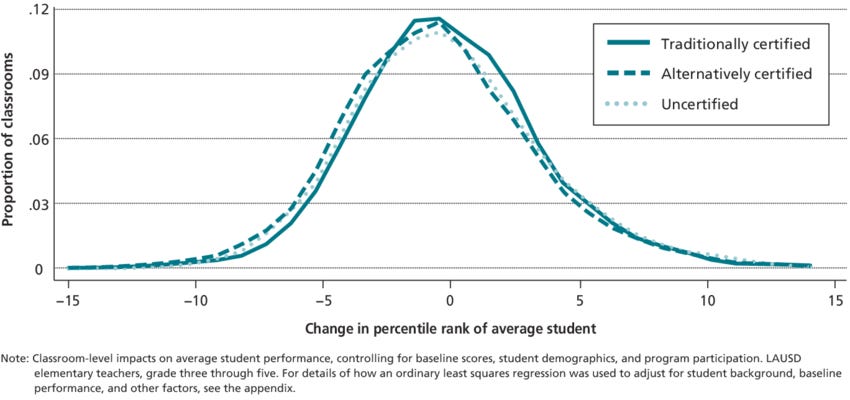
The National Home Education Research Institute found that whether homeschooling parents were ever certified teachers is not notably related to their children’s academic achievement. Homeschool students score above average on achievement tests regardless of their parents’ level of formal education or their family’s household income.
The teaching credential is not a quality filter. It is a barrier to entry that restricts the supply of people who can legally teach while producing no detectable improvement in the quality of teaching. It is the educational equivalent of a taxi medallion. It does not make the ride better. It makes sure fewer people can offer one.
The Socialization Question
If you mention homeschooling to someone who has never done it, the first question is always: “But what about socialization?”
The assumption is that placing 30 age-matched children in a room with one adult for seven hours a day produces healthy social development, and that any departure from this model creates deficits. The research says the opposite.
Dr. Richard Medlin of Stetson University, who has studied homeschool socialization for over two decades, found that homeschooled children have higher quality friendships, better relationships with parents and other adults, less emotional turmoil, and a stronger sense of social responsibility than their conventionally schooled peers. As adolescents, they exhibit fewer problem behaviors. As college students, they are socially involved and open to new experiences. As adults, they are civically engaged and functioning competently in every measured dimension.
Sixty-four percent of peer-reviewed studies on social, emotional, and psychological development show homeschool students perform statistically significantly better than those in conventional schools. A 2025 study by Cheng and Watson found that long-term homeschoolers had the lowest depression and anxiety scores and the highest life satisfaction scores of all groups studied.
Homeschooled students are less likely to use drugs, less likely to abuse alcohol, and more likely to volunteer in their communities. Ninety-eight percent participate in extracurricular activities, averaging five activities outside the home.
The “socialization” objection rests on the assumption that the school model is the only model. It is not. It is simply the most familiar one. Homeschooled children interact with a wider age range, including siblings, co-op members, community groups, and adults. They are not sealed in a room with thirty people born in the same twelve-month window. The question is not whether homeschooled children are socialized. It is whether forced interaction with same-age peers in an institutional setting is actually the optimal socialization environment. There is no evidence that it is. There is considerable evidence that it is not.
The Abuse Objection
The most emotionally potent argument for regulating homeschooling is child safety. The claim is that homeschooling provides cover for abusive parents to hide their children from the system.
The data does not support this.
Connecticut’s Office of the Child Advocate found that in a randomly selected group of 774 homeschooled children, 23% came from households with at least one child protective services report. Proponents of regulation cited this as evidence that homeschooling families require additional oversight.
They should have checked the baseline. A peer-reviewed study in the American Journal of Public Health found that approximately 37% of all children in the United States experience a CPS investigation by age 18. The homeschool population’s rate of 23% is substantially lower than the general population. The data the legislature cited to justify regulation actually demonstrates that homeschooling families have less child welfare involvement, not more.
In the cases where abuse does occur in homeschooling families, the child welfare system almost always already has contact with the family. The problem is not that the system lacks information. It is that the system fails to act on the information it already has. Regulating 3.7 million homeschooling families to address failures in the child protective services apparatus is collective punishment for an institutional problem.
The National Home Education Research Institute notes that the balance of research to date suggests that homeschool students may suffer less harm, including abuse, neglect, and fatalities, than conventional school students. The safest response to this data is not to expand surveillance of the population with lower rates of harm.
The Inequality Objection
The assumption that homeschooling is a privilege available only to wealthy, white families does not survive contact with the data.
Forty-one percent of homeschool students are black, Asian, Hispanic, or non-white. During the pandemic, homeschooling rates among black families nearly tripled. The median homeschooling family income is close to the national median. Many are single-income households that made a deliberate financial sacrifice to educate their children at home.
At $600 to $3,000 per student annually, homeschooling costs a fraction of the $16,446 per-pupil public school expenditure that families are already funding through property taxes and not using. These families are paying for public schools they chose to leave and funding their own alternative out of pocket. The inequality objection has the direction of subsidy exactly backwards.
The Institutional Immune Response
Across the country, state legislatures are introducing bills to increase oversight of homeschooling. Connecticut’s HB 5468 would require annual demonstrations of “equivalent instruction” benchmarked against public school standards, DCF background checks before withdrawal from public school, and mandatory registration with the district. Similar proposals have appeared in other states.
The pattern is consistent. When a system is outperformed by an alternative, the institutional response is not to reform the system. It is to regulate the alternative.
“Equivalent instruction” is a revealing phrase. It requires homeschooling families to demonstrate that their children’s education is equivalent to a system that spends seven times more per student and produces outcomes 37 percentile points lower. The benchmark is the institution, not the child. A homeschooled student in the 87th percentile is, by this standard, only acceptable if the method that got them there looks enough like the method that produces the 50th percentile.
This is not quality assurance. It is institutional self-preservation. The same pattern appears in occupational licensing, taxi regulation, healthcare credentialing, and every other domain where incumbents use regulatory capture to eliminate competition they cannot match on performance.
What the System Actually Optimizes For
The public education system is not optimized for learning. It is optimized for inputs. Headcount, compliance, credentialing, administrative growth, funding formulas. Every incentive in the system points toward more staff, more spending, and more process. No incentive points toward outcomes.
A system that measured outputs would look completely different. It would reward the methods that produce the highest achievement at the lowest cost. It would study what homeschooling families do and try to replicate the structural advantages: individualized pacing, incentive alignment between instructor and student, flexibility in curriculum, and a feedback loop that connects effort to results in real time.
Instead, the system measures inputs and punishes the alternative that measures outputs. The $16,446 system with flat test scores proposes to regulate the $3,000 system with 87th percentile results. The credentialed teachers who produce identical outcomes to uncredentialed ones propose to require credentials of the parents who outperform both.
The pattern is not new. It is the same pattern I have written about in taxation, gun policy, and government spending. The system optimizes for itself. It measures what it controls. And when something outside the system demonstrates that the measurements are wrong, the system does not reform itself. It regulates the competition. It does not ask why homeschooling produces better outcomes at a fraction of the cost. It asks how to make homeschooling harder. The system would rather every child in America score in the 50th percentile inside the institution than in the 87th percentile outside of it. That is not education policy. It is institutional survival dressed as concern for children.
The $3,000 School
There are roughly 3.7 million homeschooled students in the United States. Their families save taxpayers an estimated $51 billion annually. They outperform the public system on every academic metric. They score higher on social, emotional, and psychological measures. They are more civically engaged, less likely to use drugs, and more likely to volunteer.
The system that produces these results costs $3,000. The system that doesn’t costs $16,446. The second system’s response to the first is not curiosity. It is regulation.
That tells you everything you need to know about what the system is actually optimizing for. And it is not your children.
Second Order Effects
Policy analysis through the lens of unintended consequences and incentives.